


(954)473-2955
9:30am - 5:00PM
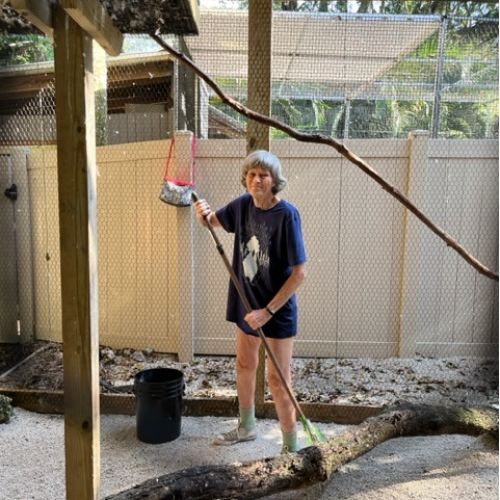
Volunteer of the Month for July is Gabriella Randall.
In this month Gabriella has amassed over 50 hours and has been so useful everywhere. She has worked in our gift shop, events, food services, and even maintenance. Gabriella takes initiative and points out areas of interest in which she can be an asset as a volunteer and that’s a quality we really love. She wants to be where ever she can make a direct and immediate impact and that is why we are so glad to have her.


The Florida Everglades is an ecosystem found nowhere else on earth, and its very existence is constantly under threat. In order to preserve this natural wonder, we all need to make changes. As the source of our drinking water, home to species of flora and fauna found nowhere else on earth, and a major layover for hundreds of migratory bird species, we must make sure that we take the steps necessary to ensure its preservation for generations to come.

One of the greatest threats to the Everglades is habitat destruction, and pollution is a major contributor. Every day, about 1,650 people move to Florida. With these new residents comes increased single-use plastics, increased water consumption, increased solid waste, and urban sprawl that moves us closer and closer to this precious habitat. In South Florida, roughly eight million people depend on the Florida Everglades for their drinking water. Much of the water we drink comes from the Biscayne Aquifer, an underground river that is replenished by the flow of water through the Everglades, whose wetlands filter out the impurities. Impurities that can’t be filtered out, however, are microplastics. Plastics persist in the environment forever. Even when they are broken down over multiple lifetimes, tiny plastic particles remain and are consumed by fish, birds and animals, eventually making their way into our bodies through the food that we eat. Other impurities that pollute the water in the Everglades are chemicals and pesticides from farming which leech into the groundwater, and as runoff into the wetlands. These toxic chemicals not only end up in our water, but they affect the hundreds of thousands of birds which live in or pass through the Florida Everglades on their annual migration. For these reasons and more, preserving and protecting the Everglades is imperative, AND YOU CAN HELP!
By making small changes such as reducing our use of plastics, reusing our waste products and conserving water, together we can impact great change. Flamingo Gardens is poised to present education on everyday changes that can make a difference to over a quarter of a million guests each year. By presenting information through signage, classes, programs and events, Flamingo Gardens aims to educate and inspire the public to make changes in their everyday lives to help preserve the Everglades.

We invite you to join us and “Be EPIC”. That stands for Everglades Preservation Involves Change.
We know it won’t be easy. It is going to take all of us making changes to achieve the following goals:
Water conservation – Did you know that Flamingo Gardens consumed 5,104,000 gallons of city water in 2022? Our goal for the next year is to reduce our city-water consumption by 5%. That’s just over 250,000 gallons of water which is a significant amount of water to be saved. At home, you can take steps to reduce your water consumption by installing low-flow sinks and low-capacity toilets, fixing leaky pipes and hoses, only running your dishwasher when it is full, and turning off the water when brushing your teeth.
Reduced single-use plastic consumption – Did you know that in 2022, Flamingo Gardens sold over 17,000 beverages in single-use plastic bottles? Our goal is to completely stop sales of all plastic drink bottles at Flamingo Gardens in the next year. Plan on seeing more water refill stations throughout the gardens, and pick up a Flamingo Gardens reusable water bottle next time you’re in the Gift Shop. At home, you can reduce single-use plastic consumption by replacing bottled shampoo with a shampoo bar, ditching plastic straws for the reusable stainless-steel variety, asking for no extras when you get takeout, and bringing your own reusable bags when you shop.
Composting – Did you know that Flamingo Gardens has a compost pile? Our Horticulture Department has been composting plant material at the nursery for well over a year, and that compost material is used throughout the gardens as rich soil. Our goal is to increase compost production at Flamingo Gardens by 50% in the next year, by installing compost collection stations at the Flamingo Pond Snack Bar / Grill and in our Animal Care clinic. You can compost your own organic waste at home and use it in your own garden. Some cities are implementing composting city-wide, and if your city isn’t one of them, you can advocate for that change.

All of these changes won’t happen overnight, but we are excited to implement strategies here at Flamingo Gardens, with your help, to preserve our precious resource and natural wonder, the Florida Everglades. Keep an eye out for new signage and more as we roll out our Be EPIC campaign in the coming months.


Our Volunteer Spotlight for June is Kaitlyn Dunne. Kaitlyn started volunteering this month but has already contributed over 90 hours of her time to Flamingo Gardens. She has literally been here almost every day. She has been a guide in the gallery for our new Lego exhibit. She has been a garden guide. Kaitlyn has also assisted gift shop, events, animal care and tram in the time she has been here. We feel thankful that we have Kaitlyn because she has really made her mark as a volunteer already.


Our volunteer of the month for May is Angel Diaz. Angel has being supremely helpful in a myriad of ways since starting at the beginning of this month. Angel has amassed over 140 hours in this month alone. He was crucial in helping us get our new exhibits set up with our events department as well as playing an integral role in breaking down the previous exhibit. He has been willing to put in extra effort at every call and get his hands dirty and that’s why have been lucky to have him.

The dodo (Raphus cucullatus) is an extinct species of bird that once lived on Mauritius island off the coast of Madagascar. Dodos have become a symbol of human-caused extinction. The dodo is also the centerpiece of a new exhibit at Flamingo Gardens highlighting the impact of Climate Change on wildlife. Sean Kenney’s Nature POP®! exhibit of 44 sculptures made from more than 800,000 LEGO® bricks consider the interconnectedness of nature and climate change through the highly stylized, colorful displays.
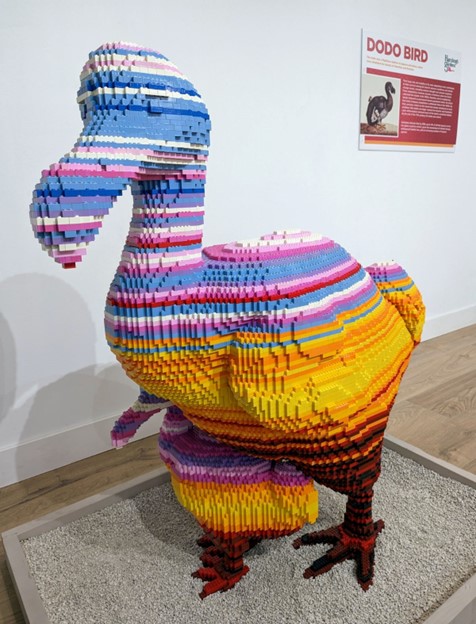
The dodo was a flightless relative of pigeons and doves, which once inhabited the islands of Mauritius and Reunion. Their large size and inability to fly were adaptations that contributed to their survival among the island’s adverse conditions and climate change events, including extreme drought and volcanic eruptions. These adaptations, however, became a hindrance when the Dutch colonized the islands in the 1600s. Mauritius and its neighboring islands harbored no permanent human population before the Dutch East India Company established a settlement there in the 1600s. By then, previous visitors to the island had already introduced so many predators that dodos no longer roamed the beaches and mountains. Later, deforestation removed much of the dodo’s woodland habitat. By the end of the 17th century, the dodo was extinct.

Estimates show that by 2100, up to 14% of all bird species across the globe could be extinct, given the momentum of climate change, widespread habitat loss, and an increasing number of invasive species.
It’s not just birds that will be affected. Biologists are becoming more and more concerned that global climate change will drastically reduce wildlife biodiversity. Some biologists estimate that 35% of animals and plants could become extinct in the wild by 2050 due to global climate change.
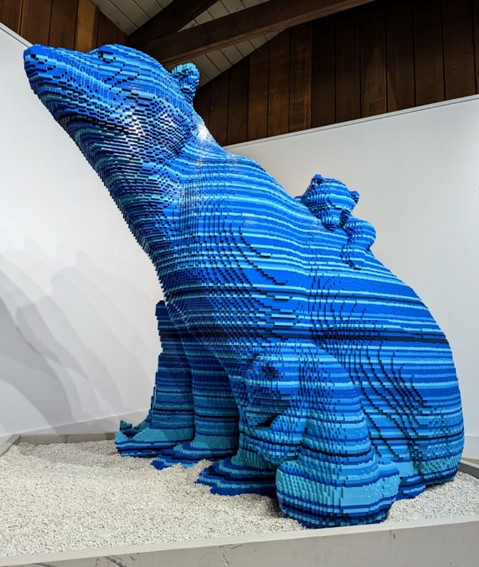
To date, global warming has been most pronounced in the Artic, and this trend is projected to continue. Temperatures in the Arctic are rising nearly four times as fast as the global average, and Arctic Sea ice extent has declined since 1979 for every month of each year. There are suggestions that before mid-century we could have a nearly ice-free Artic in the summer and two-thirds of the world’s polar bears could be extinct if greenhouse gas-fueled global warming keeps melting their Arctic Sea ice habitat.

A recent two-year drought in Kenya has wiped out 2% of the world’s rarest zebra species as the climate crisis continues to take its toll on Africa’s wildlife. The Grévy’s zebra is in rapid decline, with estimates that their population has decreased by 50% over the last 18 years, attributed in part to having one of the most substantial reductions of range of any African mammal. Once found roaming across Ethiopia, Kenya, Djibouti, and Somalia, the animal is now confined to Ethiopia and Kenya, with an estimated 1,966 to 2,447 left in the wild. The biggest threat to zebra populations are habitat loss and drought. Increasing temperatures and changes to the rainy seasons mean lack of water for zebras, forcing them to congregate at the remaining water sources where there is an increased chance of disease.

Most of the time when we think about climate change, we think about warming temperatures. However, rainfall patterns will change as well, which is something that insects seem to be especially sensitive to. Rainfall extremes can have negative effects on insect populations over very short timescales.
Insects are incredibly diverse and important, filling the ecosystem roles of pollination and decomposition, and as a food source for many birds and mammals. Spiders eat an astronomical number of insects, many of which are agricultural pests or the carriers of human diseases. Their loss will become ours as it impacts future ecosystems.

Several traits make the monarch vulnerable to a changing climate. Like most butterflies, they are extremely sensitive to weather and climate, depending on environmental cues (temperature in particular) to trigger reproduction, migration, and hibernation. Their dependence on milkweed alone as a host plant is a further vulnerability, particularly as milkweed abundance is declining throughout the monarch range.
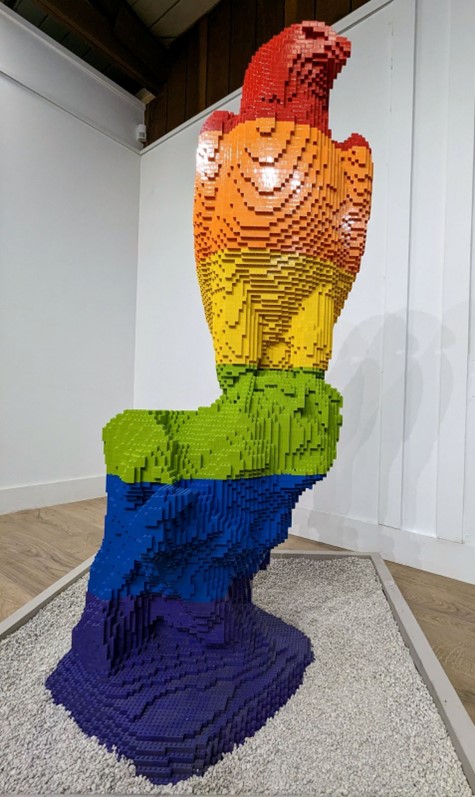
The bald eagle is a resilient species, and often held up as a symbol for conservation success. But as the climate changes, they too face new challenges. Extreme temperatures cause drought which threatens bodies of water that eagles depend on. Stream temperatures have spiked in recent years as glaciers retreat and provide less cool water, affecting cold-water species like salmon that bald eagles rely on for food. Climate change has also led to heavier river flows and floods in late fall, washing dead salmon out to sea before they can be eaten by eagles.
Global warming also brings extreme weather and damaging winds that can endanger nests and baby birds, and in the south, extreme heat which could threaten the bird’s ability to reproduce. Taking all these factors into account, the Audubon Society predicts that three quarters of the bald eagles’ current summer range will become unsuitable for the birds in 60 years’ time.

Sculptures featured in Sean Kenney’s Nature Pop®! exhibit include a polar bear, zebra, lion, snow leopard, rabbits, dragon flies, and many more. Nature Pop®! hopes to engage young brick-building enthusiasts and inspire acts of art, preservation, and conservation while educating the public about Climate Change and its impact on global wildlife.
Sean Kenney’s Nature Pop®! is on display at Flamingo Gardens May 27 to September 4, 2023. Tickets are included with the price of admission. For more information, visit www.FlamingoGardens.org or call 954-473-2955.


Special Raw Essences Flow (Yoga and Aromatherapy)
Join us Sunday, May 28th at 8:30 AM for a special Raw Essences Flow with Cintia Wess. Reset your body, mind, and soul with a combination of yoga and aromatherapy that will help keep you in harmony with nature.
“Feel Good” Flow with Sarah Freemyer will return on Sunday, June 4th.



TALLAHASSEE – Florida Secretary of State Laurel M. Lee and the Florida Department of State announced the fifth annual “March of Museums” celebrating the variety and versatility of museums in Florida and the important services those museums provide to their communities. The initiative includes partner museums and cultural institutions throughout Florida that showcase the vast and diverse array of museums that populate the Sunshine State.
“As Florida’s Chief Cultural Officer, I’m proud highlight the important role that museums play in preserving Florida’s history and resources”, said Florida Secretary of State Laurel M. Lee. “With institutions focused on history, art, nature, and more, the diversity of participants in March of Museums illustrates the many aspects of Florida’s unique cultural landscape.”
The department is hosting MarchofMuseums.com, which offers a listing and map of museums by region, including Flamingo Gardens and other statewide partner museums. The website also highlights the mission, collections, and/or events of each institution during the month of March. The department encourages visitors and Floridians to take advantage of March of Museums initiative to spend some time at one of their favorite museums, or to discover a new museum, and to share their pictures on social media using #MarchOfMuseums.
Genevieve Marcello, Director of Special Programs for Flamingo Gardens said, “March of Museums is an exciting opportunity to experience museums in our community. Be sure to check out our exciting March exhibits “Pollinator Investigation” and “Portrait of a Pollinator”.
Flamingo Gardens has partnered with the Florida Department of State to encourage Floridians and visitors to Florida to experience the many ways that museums serve the community. Visit MarchOfMuseums.com for more information.

On February 4th, the Eco-teers visited Charnow Park in Hollywood Beach, Florida. The focus of their work on dune restorations was a huge success! 3000 sea oats were planted in partnership with the Youth Environmental Alliance. The morning brought in tremendous amount of rain, but that did not stop the amazing volunteers from serving their community.

Sand dunes play an important role in our Florida beaches, providing habitat for several coastal species and protection from storms. The dunes are a naturally-occurring accumulation of wind-blown sand. As they grow they are colonized by plants such as sea oats, sand spurs and beach morning glory, to name a few.

The Eco-teers planted sea oats due to Its massive root system which is capable of holding soil and sand in place during extreme weather events such as hurricanes and tropical storms. This plant’s habitat puts it at the forefront of shoreline protection.

Acting as a wall, sand dunes help protect beaches and property from damage from high winds, storm surges, waves and tides. The dunes are the first line of defense for homes and businesses. it’s important to avoid walking on them as foot traffic in dunes tramples vegetation and causes erosion over time.

If you would like to make meaningful and impactful change in your community, please email the Eco-teer Coordinator, Glennys Navarrete, at [email protected] for an application and updates on the upcoming projects.